Fiber fuse

3:19 PM Edit This 0 Comments »
At high optical intensities, above 2 megawatts per square centimeter, when a fiber is subjected to a shock or is otherwise suddenly damaged, a fiber fuse can occur. The reflection from the damage vaporizes the fiber immediately before the break, and this new defect remains reflective so that the damage propagates back toward the transmitter at 1–3 meters per second (4−11 km/h, 2–8 mph).[16][17] The open fiber control system, which ensures laser eye safety in the event of a broken fiber, can also effectively halt propagation of the fiber fuse.[18] In situations, such as undersea cables, where high power levels might be used without the need for open fiber control, a "fiber fuse" protection device at the transmitter can break the circuit to prevent any damage.

Free-space coupling of Fiber

3:19 PM Edit This 0 Comments »
It often becomes necessary to align an optical fiber with another optical fiber or an optical device such as a light-emitting diode, a laser diode, or an optoelectronic device such as a modulator. This can involve either carefully aligning the fiber and placing it in contact with the device to which it is to couple, or can use a lens to allow coupling over an air gap. In some cases the end of the fiber is polished into a curved form that is designed to allow it to act as a lens.

In a laboratory environment, the fiber end is usually aligned to the device or other fiber with a fiber launch system that uses a microscope objective lens to focus the light down to a fine point. A precision translation stage (micro-positioning table) is used to move the lens, fiber, or device to allow the coupling efficiency to be optimized.

Termination and splicing of fiber

3:16 PM Edit This 0 Comments »
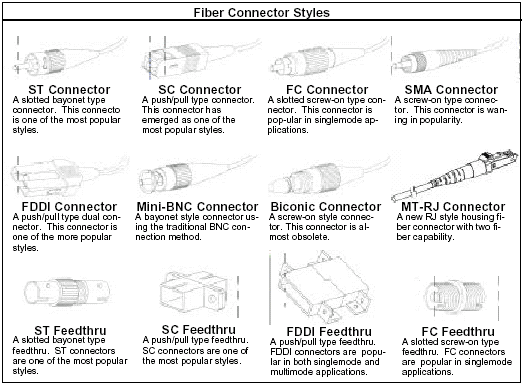
Optical fibers are connected to terminal equipment by optical fiber connectors. These connectors are usually of a standard type such as FC, SC, ST, LC, or MTRJ.

Optical fibers may be connected to each other by connectors or by splicing, that is, joining two fibers together to form a continuous optical waveguide. The generally accepted splicing method is arc fusion splicing, which melts the fiber ends together with an electric arc. For quicker fastening jobs, a "mechanical splice" is used.

Fusion splicing is done with a specialized instrument that typically operates as follows: The two cable ends are fastened inside a splice enclosure that will protect the splices, and the fiber ends are stripped of their protective polymer coating (as well as the more sturdy outer jacket, if present). The ends are cleaved (cut) with a precision cleaver to make them perpendicular, and are placed into special holders in the splicer. The splice is usually inspected via a magnified viewing screen to check the cleaves before and after the splice. The splicer uses small motors to align the end faces together, and emits a small spark between electrodes at the gap to burn off dust and moisture. Then the splicer generates a larger spark that raises the temperature above the melting point of the glass, fusing the ends together permanently. The location and energy of the spark is carefully controlled so that the molten core and cladding don't mix, and this minimizes optical loss. A splice loss estimate is measured by the splicer, by directing light through the cladding on one side and measuring the light leaking from the cladding on the other side. A splice loss under 0.1 dB is typical. The complexity of this process makes fiber splicing much more difficult than splicing copper wire.

Mechanical fiber splices are designed to be quicker and easier to install, but there is still the need for stripping, careful cleaning and precision cleaving. The fiber ends are aligned and held together by a precision-made sleeve, often using a clear index-matching gel that enhances the transmission of light across the joint. Such joints typically have higher optical loss and are less robust than fusion splices, especially if the gel is used. All splicing techniques involve the use of an enclosure into which the splice is placed for protection afterward.

Fibers are terminated in connectors so that the fiber end is held at the end face precisely and securely. A fiber-optic connector is basically a rigid cylindrical barrel surrounded by a sleeve that holds the barrel in its mating socket. The mating mechanism can be "push and click", "turn and latch" ("bayonet"), or screw-in (threaded). A typical connector is installed by preparing the fiber end and inserting it into the rear of the connector body. Quick-set adhesive is usually used so the fiber is held securely, and a strain relief is secured to the rear. Once the adhesive has set, the fiber's end is polished to a mirror finish. Various polish profiles are used, depending on the type of fiber and the application. For single-mode fiber, the fiber ends are typically polished with a slight curvature, such that when the connectors are mated the fibers touch only at their cores. This is known as a "physical contact" (PC) polish. The curved surface may be polished at an angle, to make an "angled physical contact" (APC) connection. Such connections have higher loss than PC connections, but greatly reduced back reflection, because light that reflects from the angled surface leaks out of the fiber core; the resulting loss in signal strength is known as gap loss. APC fiber ends have low back reflection even when disconnected.


ST connectors on multi-mode fiber.

Optical Fiber Cables

3:16 PM Edit This 0 Comments »
In practical fibers, the cladding is usually coated with a tough resin buffer layer, which may be further surrounded by a jacket layer, usually plastic. These layers add strength to the fiber but do not contribute to its optical wave guide properties. Rigid fiber assemblies sometimes put light-absorbing ("dark") glass between the fibers, to prevent light that leaks out of one fiber from entering another. This reduces cross-talk between the fibers, or reduces flare in fiber bundle imaging applications.[11][12]

Modern cables come in a wide variety of sheathings and armor, designed for applications such as direct burial in trenches, high voltage isolation, dual use as power lines,[13][not in citation given] installation in conduit, lashing to aerial telephone poles, submarine installation, and insertion in paved streets. The cost of small fiber-count pole-mounted cables has greatly decreased due to the high Japanese and South Korean demand for fiber to the home (FTTH) installations.

Fiber cable can be very flexible, but traditional fiber's loss increases greatly if the fiber is bent with a radius smaller than around 30 mm. This creates a problem when the cable is bent around corners or wound around a spool, making FTTX installations more complicated. "Bendable fibers", targeted towards easier installation in home environments, have been standardized as ITU-T G.657. This type of fiber can be bent with a radius as low as 7.5 mm without adverse impact. Even more bendable fibers have been developed.[14] Bendable fiber may also be resistant to fiber hacking, in which the signal in a fiber is surreptitiously monitored by bending the fiber and detecting the leakage

Manufacturing of Fiber Optic

3:12 PM Edit This 0 Comments »
Materials

Glass optical fibers are almost always made from silica, but some other materials, such as fluorozirconate, fluoroaluminate, and chalcogenide glasses, are used for longer-wavelength infrared applications. Like other glasses, these glasses have a refractive index of about 1.5. Typically the difference between core and cladding is less than one percent.

Plastic optical fibers (POF) are commonly step-index multi-mode fibers with a core diameter of 0.5 millimeters or larger. POF typically have higher attenuation co-efficients than glass fibers, 1 dB/m or higher, and this high attenuation limits the range of POF-based systems.

Process

Standard optical fibers are made by first constructing a large-diameter preform, with a carefully controlled refractive index profile, and then pulling the preform to form the long, thin optical fiber. The preform is commonly made by three chemical vapor deposition methods: inside vapor deposition, outside vapor deposition, and vapor axial deposition.[10]
Illustration of the modified chemical vapor deposition (inside) process

With inside vapor deposition, a hollow glass tube approximately 40 cm (16 inches) in length known as a "preform" is placed horizontally and rotated slowly on a lathe, and gases such as silicon tetrachloride (SiCl4) or germanium tetrachloride (GeCl4) are injected with oxygen in the end of the tube. The gases are then heated by means of an external hydrogen burner, bringing the temperature of the gas up to 1900 kelvins (1600 °C, 3000 °F), where the tetrachlorides react with oxygen to produce silica or germania (germanium dioxide) particles. When the reaction conditions are chosen to allow this reaction to occur in the gas phase throughout the tube volume, in contrast to earlier techniques where the reaction occurred only on the glass surface, this technique is called modified chemical vapor deposition.

The oxide particles then agglomerate to form large particle chains, which subsequently deposit on the walls of the tube as soot. The deposition is due to the large difference in temperature between the gas core and the wall causing the gas to push the particles outwards (this is known as thermophoresis). The torch is then traversed up and down the length of the tube to deposit the material evenly. After the torch has reached the end of the tube, it is then brought back to the beginning of the tube and the deposited particles are then melted to form a solid layer. This process is repeated until a sufficient amount of material has been deposited. For each layer the composition can be modified by varying the gas composition, resulting in precise control of the finished fiber's optical properties.

In outside vapor deposition or vapor axial deposition, the glass is formed by flame hydrolysis, a reaction in which silicon tetrachloride and germanium tetrachloride are oxidized by reaction with water (H2O) in an oxyhydrogen flame. In outside vapor deposition the glass is deposited onto a solid rod, which is removed before further processing. In vapor axial deposition, a short seed rod is used, and a porous preform, whose length is not limited by the size of the source rod, is built up on its end. The porous preform is consolidated into a transparent, solid preform by heating to about 1800 kelvins (1500 °C, 2800 °F).

The preform, however constructed, is then placed in a device known as a drawing tower, where the preform tip is heated and the optic fiber is pulled out as a string. By measuring the resultant fiber width, the tension on the fiber can be controlled to maintain the fiber thickness.


Special-purpose Fiber Optic

3:12 PM Edit This 0 Comments »
Some special-purpose optical fiber is constructed with a non-cylindrical core and/or cladding layer, usually with an elliptical or rectangular cross-section. These include polarization-maintaining fiber and fiber designed to suppress whispering gallery mode propagation.

Photonic crystal fiber is made with a regular pattern of index variation (often in the form of cylindrical holes that run along the length of the fiber). Such fiber uses diffraction effects instead of or in addition to total internal reflection, to confine light to the fiber's core. The properties of the fiber can be tailored to a wide variety of applications.

Single-mode Fiber Optic

3:10 PM Posted In Edit This 0 Comments »
Fiber with a core diameter less than about ten times the wavelength of the propagating light cannot be modeled using geometric optics. Instead, it must be analyzed as an electromagnetic structure, by solution of Maxwell's equations as reduced to the electromagnetic wave equation. The electromagnetic analysis may also be required to understand behaviors such as speckle that occur when coherent light propagates in multi-mode fiber. As an optical waveguide, the fiber supports one or more confined transverse modes by which light can propagate along the fiber. Fiber supporting only one mode is called single-mode or mono-mode fiber. The behavior of larger-core multi-mode fiber can also be modeled using the wave equation, which shows that such fiber supports more than one mode of propagation (hence the name). The results of such modeling of multi-mode fiber approximately agree with the predictions of geometric optics, if the fiber core is large enough to support more than a few modes.

The waveguide analysis shows that the light energy in the fiber is not completely confined in the core. Instead, especially in single-mode fibers, a significant fraction of the energy in the bound mode travels in the cladding as an evanescent wave.

The most common type of single-mode fiber has a core diameter of 8–10 micrometers and is designed for use in the near infrared. The mode structure depends on the wavelength of the light used, so that this fiber actually supports a small number of additional modes at visible wavelengths. Multi-mode fiber, by comparison, is manufactured with core diameters as small as 50 micrometers and as large as hundreds of micrometres. The normalized frequency V for this fiber should be less than the first zero of the Bessel function J0 (approximately 2.405).

A typical single-mode optical fiber, showing diameters of

Multi-mode Fiber Optic

3:06 PM Posted In Edit This 0 Comments »
Fiber with large core diameter (greater than 10 micrometers) may be analyzed by geometric optics. Such fiber is called multi-mode fiber, from the electromagnetic analysis (see below). In a step-index multi-mode fiber, rays of light are guided along the fiber core by total internal reflection. Rays that meet the core-cladding boundary at a high angle (measured relative to a line normal to the boundary), greater than the critical angle for this boundary, are completely reflected. The critical angle (minimum angle for total internal reflection) is determined by the difference in index of refraction between the core and cladding materials. Rays that meet the boundary at a low angle are refracted from the core into the cladding, and do not convey light and hence information along the fiber. The critical angle determines the acceptance angle of the fiber, often reported as a numerical aperture. A high numerical aperture allows light to propagate down the fiber in rays both close to the axis and at various angles, allowing efficient coupling of light into the fiber. However, this high numerical aperture increases the amount of dispersion as rays at different angles have different path lengths and therefore take different times to traverse the fiber. A low numerical aperture may therefore be desirable.
Optical fiber types.

In graded-index fiber, the index of refraction in the core decreases continuously between the axis and the cladding. This causes light rays to bend smoothly as they approach the cladding, rather than reflecting abruptly from the core-cladding boundary. The resulting curved paths reduce multi-path dispersion because high angle rays pass more through the lower-index periphery of the core, rather than the high-index center. The index profile is chosen to minimize the difference in axial propagation speeds of the various rays in the fiber. This ideal index profile is very close to a parabolic relationship between the index and the distance from the axis.


A laser bouncing down an acrylic rod, illustrating the total internal reflection of light in a multi-mode optical fiber.


The propagation of light through a multi-mode optical fiber.


Optical fiber types.


Total internal reflection of Fiber Optic

3:04 PM Edit This 0 Comments »
When light traveling in a dense medium hits a boundary at a steep angle (larger than the "critical angle" for the boundary), the light will be completely reflected. This effect is used in optical fibers to confine light in the core. Light travels along the fiber bouncing back and forth off of the boundary. Because the light must strike the boundary with an angle greater than the critical angle, only light that enters the fiber within a certain range of angles can travel down the fiber without leaking out. This range of angles is called the acceptance cone of the fiber. The size of this acceptance cone is a function of the refractive index difference between the fiber's core and cladding.

In simpler terms, there is a maximum angle from the fiber axis at which light may enter the fiber so that it will propagate, or travel, in the core of the fiber. The sine of this maximum angle is the numerical aperture (NA) of the fiber. Fiber with a larger NA requires less precision to splice and work with than fiber with a smaller NA. Single-mode fiber has a small NA.

Index of refraction Fiber

3:04 PM Edit This 0 Comments »
The index of refraction is a way of measuring the speed of light in a material. Light travels fastest in a vacuum, such as outer space. The actual speed of light in a vacuum is about 300 million meters (186 thousand miles) per second. Index of refraction is calculated by dividing the speed of light in a vacuum by the speed of light in some other medium. The index of refraction of a vacuum is therefore 1, by definition. The typical value for the cladding of an optical fiber is 1.46. The core value is typically 1.48. The larger the index of refraction, the slower light travels in that medium.

Principle of operation Fiber

3:03 PM Edit This 0 Comments »
An optical fiber is a cylindrical dielectric waveguide that transmits light along its axis, by the process of total internal reflection. The fiber consists of a core surrounded by a cladding layer. To confine the optical signal in the core, the refractive index of the core must be greater than that of the cladding. The boundary between the core and cladding may either be abrupt, in step-index fiber, or gradual, in graded-index fiber.

Other uses of optical fibers

3:01 PM Edit This 0 Comments »

Other uses of optical fibers


Fibers are widely used in illumination applications. They are used as light guides in medical and other applications where bright light needs to be shone on a target without a clear line-of-sight path. In some buildings, optical fibers are used to route sunlight from the roof to other parts of the building (see non-imaging optics). Optical fiber illumination is also used for decorative applications, including signs, art, and artificial Christmas trees. Swarovski boutiques use optical fibers to illuminate their crystal showcases from many different angles while only employing one light source. Optical fiber is an intrinsic part of the light-transmitting concrete building product, LiTraCon.

Optical fiber is also used in imaging optics. A coherent bundle of fibers is used, sometimes along with lenses, for a long, thin imaging device called an endoscope, which is used to view objects through a small hole. Medical endoscopes are used for minimally invasive exploratory or surgical procedures (endoscopy). Industrial endoscopes (see fiberscope or borescope) are used for inspecting anything hard to reach, such as jet engine interiors.

An optical fiber doped with certain rare-earth elements such as erbium can be used as the gain medium of a laser or optical amplifier. Rare-earth doped optical fibers can be used to provide signal amplification by splicing a short section of doped fiber into a regular (undoped) optical fiber line. The doped fiber is optically pumped with a second laser wavelength that is coupled into the line in addition to the signal wave. Both wavelengths of light are transmitted through the doped fiber, which transfers energy from the second pump wavelength to the signal wave. The process that causes the amplification is stimulated emission.

Optical fibers doped with a wavelength shifter are used to collect scintillation light in physics experiments.

Optical fiber can be used to supply a low level of power (around one watt) to electronics situated in a difficult electrical environment. Examples of this are electronics in high-powered antenna elements and measurement devices used in high voltage transmission equipment

Fiber Optic Sensor

3:00 PM Edit This 0 Comments »
Fibers have many uses in remote sensing. In some applications, the sensor is itself an optical fiber. In other cases, fiber is used to connect a non-fiberoptic sensor to a measurement system. Depending on the application, fiber may be used because of its small size, or the fact that no electrical power is needed at the remote location, or because many sensors can be multiplexed along the length of a fiber by using different wavelengths of light for each sensor, or by sensing the time delay as light passes along the fiber through each sensor. Time delay can be determined using a device such as an optical time-domain reflectometer.

Optical fibers can be used as sensors to measure strain, temperature, pressure and other quantities by modifying a fiber so that the quantity to be measured modulates the intensity, phase, polarization, wavelength or transit time of light in the fiber. Sensors that vary the intensity of light are the simplest, since only a simple source and detector are required. A particularly useful feature of such fiber optic sensors is that they can, if required, provide distributed sensing over distances of up to one meter.

Extrinsic fiber optic sensors use an optical fiber cable, normally a multi-mode one, to transmit modulated light from either a non-fiber optical sensor, or an electronic sensor connected to an optical transmitter. A major benefit of extrinsic sensors is their ability to reach places which are otherwise inaccessible. An example is the measurement of temperature inside aircraft jet engines by using a fiber to transmit radiation into a radiation pyrometer located outside the engine. Extrinsic sensors can also be used in the same way to measure the internal temperature of electrical transformers, where the extreme electromagnetic fields present make other measurement techniques impossible. Extrinsic sensors are used to measure vibration, rotation, displacement, velocity, acceleration, torque, and twisting.

Optical Fiber Communication

2:59 PM Edit This 0 Comments »
Optical fiber can be used as a medium for telecommunication and networking because it is flexible and can be bundled as cables. It is especially advantageous for long-distance communications, because light propagates through the fiber with little attenuation compared to electrical cables. This allows long distances to be spanned with few repeaters. Additionally, the per-channel light signals propagating in the fiber can be modulated at rates as high as 111 gigabits per second,[9] although 10 or 40 Gb/s is typical in deployed systems.[citation needed] Each fiber can carry many independent channels, each using a different wavelength of light (wavelength-division multiplexing (WDM)). The net data rate (data rate without overhead bytes) per fiber is the per-channel data rate reduced by the FEC overhead, multiplied by the number of channels (usually up to eighty in commercial dense WDM systems as of 2008[update]).
Justify Full
Over short distances, such as networking within a building, fiber saves space in cable ducts because a single fiber can carry much more data than a single electrical cable.[vague] Fiber is also immune to electrical interference; there is no cross-talk between signals in different cables and no pickup of environmental noise. Non-armored fiber cables do not conduct electricity, which makes fiber a good solution for protecting communications equipment located in high voltage environments such as power generation facilities, or metal communication structures prone to lightning strikes. They can also be used in environments where explosive fumes are present, without danger of ignition. Wiretapping is more difficult compared to electrical connections, and there are concentric dual core fibers that are said to be tap-proof.

Although fibers can be made out of transparent plastic, glass, or a combination of the two, the fibers used in long-distance telecommunications applications are always glass, because of the lower optical attenuation. Both multi-mode and single-mode fibers are used in communications, with multi-mode fiber used mostly for short distances, up to 550 m (600 yards), and single-mode fiber used for longer distance links. Because of the tighter tolerances required to couple light into and between single-mode fibers (core diameter about 10 micrometers), single-mode transmitters, receivers, amplifiers and other components are generally more expensive than multi-mode components.

History Of Optical Fiber

2:51 PM Edit This 0 Comments »
Daniel Colladon first described this "light fountain" or "light pipe" in an 1842 article entitled On the reflections of a ray of light inside a parabolic liquid stream. This particular illustration comes from a later art
Guiding of light by refraction, the principle that makes fiber optics possible, was first demonstrated by Daniel Colladon and Jacques Babinet in Paris in the early 1840s. John Tyndall included a demonstration of it in his public lectures in London a dozen years later.[1] Tyndall also wrote about the property of total internal reflection in an in introductory book about the nature of light in 1870: "When the light passes from air into water, the refracted ray is bent towards the perpendicular... When the ray passes from water to air it is bent from the perpendicular... If the angle which the ray in water encloses with the perpendicular to the surface be greater than 48 degrees, the ray will not quit the water at all: it will be totally reflected at the surface.... The angle which marks the limit where total reflexion begins is called the limiting angle of the medium. For water this angle is 48°27', for flint glass it is 38°41', while for diamond it is 23°42'."[2][3]

Practical applications, such as close internal illumination during dentistry, appeared early in the twentieth century. Image transmission through tubes was demonstrated independently by the radio experimenter Clarence Hansell and the television pioneer John Logie Baird in the 1920s. The principle was first used for internal medical examinations by Heinrich Lamm in the following decade. In 1952, physicist Narinder Singh Kapany conducted experiments that led to the invention of optical fiber. Modern optical fibers, where the glass fiber is coated with a transparent cladding to offer a more suitable refractive index, appeared later in the decade.[1] Development then focused on fiber bundles for image transmission. The first fiber optic semi-flexible gastroscope was patented by Basil Hirschowitz, C. Wilbur Peters, and Lawrence E. Curtiss, researchers at the University of Michigan, in 1956. In the process of developing the gastroscope, Curtiss produced the first glass-clad fibers; previous optical fibers had relied on air or impractical oils and waxes as the low-index cladding material. A variety of other image transmission applications soon followed.

In 1965, Charles K. Kao and George A. Hockham of the British company Standard Telephones and Cables (STC) were the first to promote the idea that the attenuation in optical fibers could be reduced below 20 decibels per kilometer, allowing fibers to be a practical medium for communication.[4] They proposed that the attenuation in fibers available at the time was caused by impurities, which could be removed, rather than fundamental physical effects such as scattering. The crucial attenuation level of 20 dB/km was first achieved in 1970, by researchers Robert D. Maurer, Donald Keck, Peter C. Schultz, and Frank Zimar working for American glass maker Corning Glass Works, now Corning Incorporated. They demonstrated a fiber with 17 dB/km attenuation by doping silica glass with titanium. A few years later they produced a fiber with only 4 dB/km attenuation using germanium dioxide as the core dopant. Such low attenuations ushered in optical fiber telecommunications and enabled the Internet. In 1981, General Electric produced fused quartz ingots that could be drawn into fiber optic strands 25 miles (40 km) long.[5]

Attenuations in modern optical cables are far less than those in electrical copper cables, leading to long-haul fiber connections with repeater distances of 50–80 km (30–50 miles). The erbium-doped fiber amplifier, which reduced the cost of long-distance fiber systems by reducing or even in many cases eliminating the need for optical-electrical-optical repeaters, was co-developed by teams led by David N. Payne of the University of Southampton, and Emmanuel Desurvire at Bell Laboratories in 1986. The more robust optical fiber commonly used today utilizes glass for both core and sheath and is therefore less prone to aging processes. It was invented by Gerhard Bernsee in 1973 of Schott Glass in Germany.[6]

In 1991, the emerging field of photonic crystals led to the development of photonic-crystal fiber[7] which guides light by means of diffraction from a periodic structure, rather than total internal reflection. The first photonic crystal fibers became commercially available in 2000.[8] Photonic crystal fibers can be designed to carry higher power than conventional fiber, and their wavelength dependent properties can be manipulated to improve their performance in certain applications.


Transfer Function of Optical Fiber

2:42 PM Edit This 0 Comments »
transfer function: 1. A mathematical statement that describes the transfer characteristics of a system, subsystem, or equipment. 2. The relationship between the input and the output of a system, subsystem, or equipment in terms of the transfer characteristics. Note 1: When the transfer function operates on the input, the output is obtained. Given any two of these three entities, the third can be obtained. Note 2: Examples of simple transfer functions are voltage gains, reflection coefficients, transmission coefficients, and efficiency ratios. An example of a complex transfer function is envelope delay distortion. Note 3: For a negative feedback circuit, the transfer function, T , is given by

where e o is the output, e i is the input, G is the forward gain, and H is the backward gain, i.e., the fraction of the output that is fed back and combined with the input in a subtracter. 3 . Of an optical fiber, the complex mathematical function that expresses the ratio of the variation, as a function of modulation frequency, of the instantaneous power of the optical signal at the output of the fiber, to the instantaneous power of the optical signal that is launched into the fiber. Note: The optical detectors used in communication applications are square-law devices. Their output current is proportional to the input optical power. Because electrical power is proportional to current, when the optical power input drops by one-half (3 dB), the electrical power at the output of the detector drops by three-quarters (6 dB). [FAA]

Function Into Optical Fiber

2:38 PM Edit This 0 Comments »
Optical fiber helped bring us the Internet, and silicon/germanium devices brought us microelectronics. Now, a joint team from Penn State University and the University of Southampton has developed a new way to combine these technologies. The team has made semiconductor devices, including a transistor, inside microstructured optical fibers. The resulting ability to generate and manipulate signals inside optical fibers could have applications in fields as diverse as medicine, computing, and remote sensing devices.

Optical fiber has proved to be the ideal medium for transmitting signals based on light, while crystalline semiconductors are the best way to manipulate electrons. One of the greatest current technological challenges is exchanging information between optics and electronics rapidly and efficiently. This new technique may provide the tools to cross the divide. The results of this research will be published in the 17 March edition of the journal Science.

"This advance is the basis for a technology that could build a large range of devices inside an optical fiber," said John Badding, associate professor of chemistry at Penn State University. While the optical fiber transmits data, a semiconductor device allows active manipulation of the light, including generating and detecting, amplifying signals, and controlling wavelengths. "If the signal never leaves the fiber, then it is faster, cheaper and more efficient," said Badding. "

"This fusion of two separate technologies opens the possibility of true optoelectronic devices that do not require conversion between optical and electronic signals," said Pier Sazio, senior research fellow in the Optoelectronics Research Centre at the University of Southampton (UK). "If you think of the fiber as a water main, this structure places the pumping station inside the pipe. The glass fiber provides the transmission and the semiconductor provides the function."

Beyond telecommunications, optical fibers are used in a wide range of technologies that employ light. "For example, in endoscopic surgery, by building a laser inside the fiber you might be able to deliver a wavelength that could not otherwise be used," said Badding.

The key breakthrough was the ability to form crystalline semiconductors that nearly fill the entire inside diameter, or pore, of very narrow glass capillaries. These capillaries are optical fibers--long, clear tubes that can carry light signals in many wavelengths simultaneously. When the tube is filled with a crystalline semiconductor, such as germanium, the semiconductor forms a wire inside the optical fiber. The combination of optical and electrical capabilities provides the platform for development of new optoelectronic devices.

The crystals were formed using chemical vapor deposition (CVD) to deposit germanium and other semiconductors inside the long, narrow pores of the hollow optical fiber. In the CVD process, a germanium compound is vaporized and then forced through the pores of the fiber at pressures as high as 1000 times atmospheric pressure and temperatures up to 500°C. A chemical reaction within the fiber allows germanium to coat the interior walls of the hollow fiber and then form crystals that grow inward. "The process works so perfectly that you can get a germanium tube that has an opening in the center of only 25 nanometers through the length of the fiber," said Sazio. "This is only a tiny fraction of the diameter of the fiber pore, so it is essentially a wire." This is the first demonstration of building crystalline structures, which are best for semiconductor devices, inside the pores of the capillaries.

The team has built a simple in-fiber transistor, and they point to the success of the Erbium Doped Fiber Amplifier, which was invented at Southampton in the late 1980s, to illustrate the transformational possibilities of this technology. By incorporating the chemical element erbium into the fiber, the Erbium Amplifier allows efficient transmission of data signals in transoceanic optical fibers. "Without that kind of device, it would be necessary to periodically convert the light to an electronic signal, amplify the signal, and convert it back to light, which is expensive and inefficient" said Sazio. " Since its inception, the Erbium Amplifier has made the internet possible in its current form."

Beyond the simple devices that this research has demonstrated, the research team sees the potential for the embedded semiconductors to carry optoelectronic applications to the next level. "At present you still have electrical switching at both ends of the optical fiber," says Badding. "If we can get to the point where the signal never leaves the fiber, it will be faster and more efficient. If we can actually generate signals inside a fiber, a whole range of optoelectronic applications become possible."


This photo shows a glass fiber with a bundle of semiconductor wires emanating from it. Each wire is just 2 microns in diameter--20 times smaller than a human hair. The glass fiber is glowing from blue laser light.


Category of Optical Fibers

2:33 PM Edit This 0 Comments »


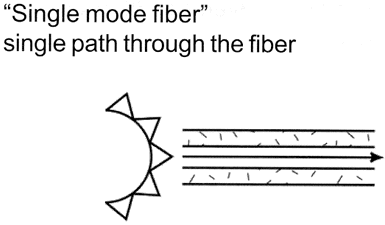
There are three types of fiber optic cable commonly used: single mode, multimode and plastic optical fiber (POF).

Transparent glass or plastic fibers which allow light to be guided from one end to the other with minimal loss.
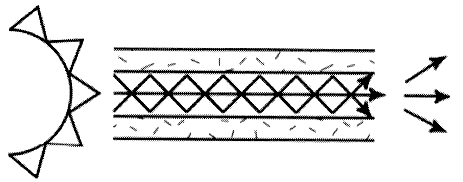
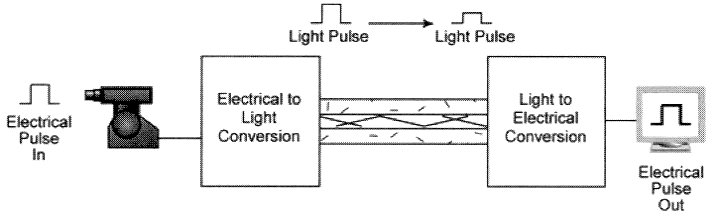
Fiber optic cable functions as a "light guide," guiding the light introduced at one end of the cable through to the other end. The light source can either be a light-emitting diode (LED)) or a laser.

The light source is pulsed on and off, and a light-sensitive receiver on the other end of the cable converts the pulses back into the digital ones and zeros of the original signal.

Even laser light shining through a fiber optic cable is subject to loss of strength, primarily through dispersion and scattering of the light, within the cable itself. The faster the laser fluctuates, the greater the risk of dispersion. Light strengtheners, called repeaters, may be necessary to refresh the signal in certain applications.

While fiber optic cable itself has become cheaper over time - a equivalent length of copper cable cost less per foot but not in capacity. Fiber optic cable connectors and the equipment needed to install them are still more expensive than their copper counterparts.

Single Mode cable is a single stand (most applications use 2 fibers) of glass fiber with a diameter of 8.3 to 10 microns that has one mode of transmission. Single Mode Fiber with a relatively narrow diameter, through which only one mode will propagate typically 1310 or 1550nm. Carries higher bandwidth than multimode fiber, but requires a light source with a narrow spectral width. Synonyms mono-mode optical fiber, single-mode fiber, single-mode optical waveguide, uni-mode fiber.

Single Modem fiber is used in many applications where data is sent at multi-frequency (WDM Wave-Division-Multiplexing) so only one cable is needed - (single-mode on one single fiber)

Single-mode fiber gives you a higher transmission rate and up to 50 times more distance than multimode, but it also costs more. Single-mode fiber has a much smaller core than multimode. The small core and single light-wave virtually eliminate any distortion that could result from overlapping light pulses, providing the least signal attenuation and the highest transmission speeds of any fiber cable type.

Single-mode optical fiber is an optical fiber in which only the lowest order bound mode can propagate at the wavelength of interest typically 1300 to 1320nm.


Multi-Mode cable has a little bit bigger diameter, with a common diameters in the 50-to-100 micron range for the light carry component (in the US the most common size is 62.5um). Most applications in which Multi-mode fiber is used, 2 fibers are used (WDM is not normally used on multi-mode fiber). POF is a newer plastic-based cable which promises performance similar to glass cable on very short runs, but at a lower cost.

Multimode fiber gives you high bandwidth at high speeds (10 to 100MBS - Gigabit to 275m to 2km) over medium distances. Light waves are dispersed into numerous paths, or modes, as they travel through the cable's core typically 850 or 1300nm. Typical multimode fiber core diameters are 50, 62.5, and 100 micrometers. However, in long cable runs (greater than 3000 feet [914.4 meters), multiple paths of light can cause signal distortion at the receiving end, resulting in an unclear and incomplete data transmission so designers now call for single mode fiber in new applications using Gigabit and beyond.
The use of fiber-optics was generally not available until 1970 when Corning Glass Works was able to produce a fiber with a loss of 20 dB/km. It was recognized that optical fiber would be feasible for telecommunication transmission only if glass could be developed so pure that attenuation would be 20dB/km or less. That is, 1% of the light would remain after traveling 1 km. Today's optical fiber attenuation ranges from 0.5dB/km to 1000dB/km depending on the optical fiber used. Attenuation limits are based on intended application.

The applications of optical fiber communications have increased at a rapid rate, since the first commercial installation of a fiber-optic system in 1977. Telephone companies began early on, replacing their old copper wire systems with optical fiber lines. Today's telephone companies use optical fiber throughout their system as the backbone architecture and as the long-distance connection between city phone systems.

Cable television companies have also began integrating fiber-optics into their cable systems. The trunk lines that connect central offices have generally been replaced with optical fiber. Some providers have begun experimenting with fiber to the curb using a fiber/coaxial hybrid. Such a hybrid allows for the integration of fiber and coaxial at a neighborhood location. This location, called a node, would provide the optical receiver that converts the light impulses back to electronic signals. The signals could then be fed to individual homes via coaxial cable.

Local Area Networks (LAN) is a collective group of computers, or computer systems, connected to each other allowing for shared program software or data bases. Colleges, universities, office buildings, and industrial plants, just to name a few, all make use of optical fiber within their LAN systems.

Power companies are an emerging group that have begun to utilize fiber-optics in their communication systems. Most power utilities already have fiber-optic communication systems in use for monitoring their power grid systems.


Fiber

by John MacChesney - Fellow at Bell Laboratories, Lucent Technologies

Some 10 billion digital bits can be transmitted per second along an optical fiber link in a commercial network, enough to carry tens of thousands of telephone calls. Hair-thin fibers consist of two concentric layers of high-purity silica glass the core and the cladding, which are enclosed by a protective sheath. Light rays modulated into digital pulses with a laser or a light-emitting diode move along the core without penetrating the cladding.

The light stays confined to the core because the cladding has a lower refractive index—a measure of its ability to bend light. Refinements in optical fibers, along with the development of new lasers and diodes, may one day allow commercial fiber-optic networks to carry trillions of bits of data per second.


Total internal refection confines light within optical fibers (similar to looking down a mirror made in the shape of a long paper towel tube). Because the cladding has a lower refractive index, light rays reflect back into the core if they encounter the cladding at a shallow angle (red lines). A ray that exceeds a certain "critical" angle escapes from the fiber (yellow line).


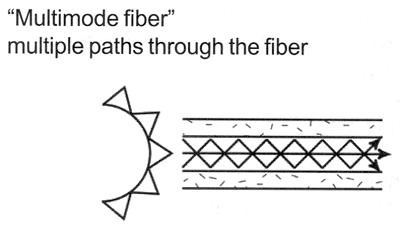
STEP-INDEX MULTIMODE FIBER has a large core, up to 100 microns in diameter. As a result, some of the light rays that make up the digital pulse may travel a direct route, whereas others zigzag as they bounce off the cladding. These alternative pathways cause the different groupings of light rays, referred to as modes, to arrive separately at a receiving point. The pulse, an aggregate of different modes, begins to spread out, losing its well-defined shape. The need to leave spacing between pulses to prevent overlapping limits bandwidth that is, the amount of information that can be sent. Consequently, this type of fiber is best suited for transmission over short distances, in an endoscope, for instance.
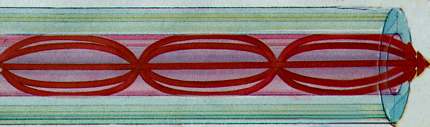

GRADED-INDEX MULTIMODE FIBER contains a core in which the refractive index diminishes gradually from the center axis out toward the cladding. The higher refractive index at the center makes the light rays moving down the axis advance more slowly than those near the cladding. Also, rather than zigzagging off the cladding, light in the core curves helically because of the graded index, reducing its travel distance. The shortened path and the higher speed allow light at the periphery to arrive at a receiver at about the same time as the slow but straight rays in the core axis. The result: a digital pulse suffers less dispersion.


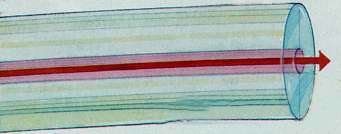
SINGLE-MODE FIBER has a narrow core (eight microns or less), and the index of refraction between the core and the cladding changes less than it does for multimode fibers. Light thus travels parallel to the axis, creating little pulse dispersion. Telephone and cable television networks install millions of kilometers of this fiber every year.

BASIC CABLE DESIGN

1 - Two basic cable designs are:

Loose-tube cable, used in the majority of outside-plant installations in North America, and tight-buffered cable, primarily used inside buildings.

The modular design of loose-tube cables typically holds up to 12 fibers per buffer tube with a maximum per cable fiber count of more than 200 fibers. Loose-tube cables can be all-dielectric or optionally armored. The modular buffer-tube design permits easy drop-off of groups of fibers at intermediate points, without interfering with other protected buffer tubes being routed to other locations. The loose-tube design also helps in the identification and administration of fibers in the system.

Single-fiber tight-buffered cables are used as pigtails, patch cords and jumpers to terminate loose-tube cables directly into opto-electronic transmitters, receivers and other active and passive components.

Multi-fiber tight-buffered cables also are available and are used primarily for alternative routing and handling flexibility and ease within buildings.

2 - Loose-Tube Cable

In a loose-tube cable design, color-coded plastic buffer tubes house and protect optical fibers. A gel filling compound impedes water penetration. Excess fiber length (relative to buffer tube length) insulates fibers from stresses of installation and environmental loading. Buffer tubes are stranded around a dielectric or steel central member, which serves as an anti-buckling element.

The cable core, typically uses aramid yarn, as the primary tensile strength member. The outer polyethylene jacket is extruded over the core. If armoring is required, a corrugated steel tape is formed around a single jacketed cable with an additional jacket extruded over the armor.

Loose-tube cables typically are used for outside-plant installation in aerial, duct and direct-buried applications.

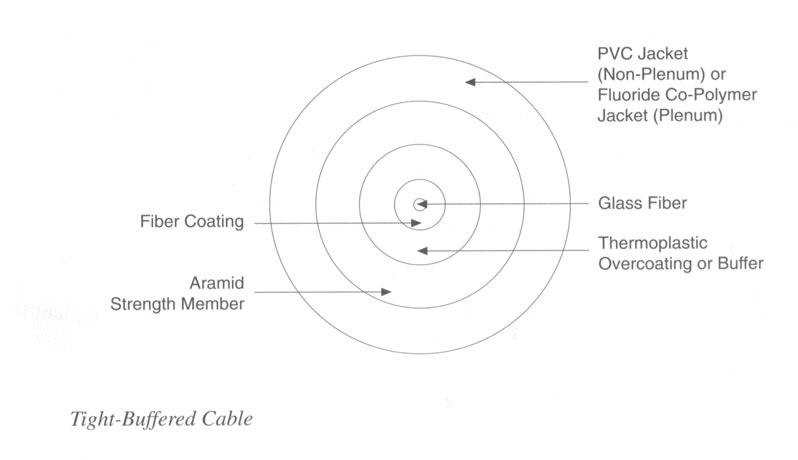
3 - Tight-Buffered Cable

With tight-buffered cable designs, the buffering material is in direct contact with the fiber. This design is suited for "jumper cables" which connect outside plant cables to terminal equipment, and also for linking various devices in a premises network.

Multi-fiber, tight-buffered cables often are used for intra-building, risers, general building and plenum applications.

The tight-buffered design provides a rugged cable structure to protect individual fibers during handling, routing and connectorization. Yarn strength members keep the tensile load away from the fiber.

As with loose-tube cables, optical specifications for tight-buffered cables also should include the maximum performance of all fibers over the operating temperature range and life of the cable. Averages should not be acceptable.


Connector Types
Gruber Industries
cable connectors


here are some common fiber cable types

Distribution Cable
Distribution Cable (compact building cable) packages individual 900µm buffered fiber reducing size and cost when compared to breakout cable. The connectors may be installed directly on the 900µm buffered fiber at the breakout box location. The space saving (OFNR) rated cable may be installed where ever breakout cable is used. FIS will connectorize directly onto 900µm fiber or will build up ends to a 3mm jacketed fiber before the connectors are installed.
Indoor/Outdoor Tight Buffer
FIS now offers indoor/outdoor rated tight buffer cables in Riser and Plenum rated versions. These cables are flexible, easy to handle and simple to install. Since they do not use gel, the connectors can be terminated directly onto the fiber without difficult to use breakout kits. This provides an easy and overall less expensive installation. (Temperature rating -40ºC to +85ºC).
Indoor/Outdoor Breakout Cable
FIS indoor/outdoor rated breakout style cables are easy to install and simple to terminate without the need for fanout kits. These rugged and durable cables are OFNR rated so they can be used indoors, while also having a -40c to +85c operating temperature range and the benefits of fungus, water and UV protection making them perfect for outdoor applications. They come standard with 2.5mm sub units and they are available in plenum rated versions.
Corning Cable Systems Freedm LST Cables
Corning Cable Systems FREEDM® LST™ cables are OFNR-rated, UV-resistant, fully waterblocked indoor/outdoor cables. This innovative DRY™ cable with water blocking technology eliminates the need for traditional flooding compound, providing more efficient and craft-friendly cable preparation. Available in 62.5µm, 50µm, Singlemode and hybrid versions.
Krone Indoor Outdoor Dry Loose Tube Cable
KRONE’s innovative line of indoor/outdoor loose tube cables are designed to meet all the rigors of the outside plant environment, and the necessary fire ratings to be installed inside the building. These cables eliminate the gel filler of traditional loose tube style cables with super absorbent polymers.
Loose Tube Cable
Loose tube cable is designed to endure outside temperatures and high moisture conditions. The fibers are loosely packaged in gel filled buffer tubes to repel water. Recommended for use between buildings that are unprotected from outside elements. Loose tube cable is restricted from inside building use, typically allowing entry not to exceed 50 feet (check your local codes).
Aerial Cable/Self-Supporting
Aerial cable provides ease of installation and reduces time and cost. Figure 8 cable can easily be separated between the fiber and the messenger. Temperature range ( -55ºC to +85ºC)
Hybrid & Composite Cable
Hybrid cables offer the same great benefits as our standard indoor/outdoor cables, with the convenience of installing multimode and singlemode fibers all in one pull. Our composite cables offer optical fiber along with solid 14 gauge wires suitable for a variety of uses including power, grounding and other electronic controls.
Armored Cable
Armored cable can be used for rodent protection in direct burial if required. This cable is non-gel filled and can also be used in aerial applications. The armor can be removed leaving the inner cable suitable for any indoor/outdoor use. (Temperature rating -40ºC to +85ºC)
Low Smoke Zero Halogen (LSZH)
Low Smoke Zero Halogen cables are offered as as alternative for halogen free applications. Less toxic and slower to ignite, they are a good choice for many international installations. We offer them in many styles as well as simplex, duplex and 1.6mm designs. This cable is riser rated and contains no flooding gel, which makes the need for a separate point of termination unnecessary. Since splicing is eliminated, termination hardware and labor times are reduced, saving you time and money. This cable may be run through risers directly to a convenient network hub or splicing closet for interconnection.


What's the best way to terminate fiber optic cable? That depends on the application, cost considerations and your own personal preferences. The following connector comparisons can make the decision easier.

Epoxy & Polish

Epoxy & polish style connectors were the original fiber optic connectors. They still represent the largest segment of connectors, in both quantity used and variety available. Practically every style of connector is available including ST, SC, FC, LC, D4, SMA, MU, and MTRJ. Advantages include:

• Very robust. This connector style is based on tried and true technology, and can withstand the greatest environmental and mechanical stress when compared to the other connector technologies.
• This style of connector accepts the widest assortment of cable jacket diameters. Most connectors of this group have versions to fit onto 900um buffered fiber, and up to 3.0mm jacketed fiber.
• Versions are. available that hold from 1 to 24 fibers in a single connector.

Installation Time: There is an initial setup time for the field technician who must prepare a workstation with polishing equipment and an epoxy-curing oven. The termination time for one connector is about 25 minutes due to the time needed to heat cure the epoxy. Average time per connector in a large batch can be as low as 5 or 6 minutes. Faster curing epoxies such as anaerobic epoxy can reduce the installation time, but fast cure epoxies are not suitable for all connectors.

Skill Level: These connectors, while not difficult to install, do require the most supervised skills training, especially for polishing. They are best suited for the high-volume installer or assembly house with a trained and stable work force.

Costs: Least expensive connectors to purchase, in many cases being 30 to 50 percent cheaper than other termination style connectors. However, factor in the cost of epoxy curing and ferrule polishing equipment, and their associated consumables.

Pre-Loaded Epoxy or No-Epoxy & Polish

There are two main categories of no-epoxy & polish connectors. The first are connectors that are pre-loaded with a measured amount of epoxy. These connectors reduce the skill level needed to install a connector but they don't significantly reduce the time or equipment need-ed. The second category of connectors uses no epoxy at all. Usually they use an internal crimp mechanism to stabilize the fiber. These connectors reduce both the skill level needed and installation time. ST, SC, and FC connector styles are available. Advantages include:

• Epoxy injection is not required.
• No scraped connectors due to epoxy over-fill.
• Reduced equipment requirements for some versions.

Installation Time: Both versions have short setup time, with pre-loaded epoxy connectors having a slightly longer setup. Due to curing time, the pre-loaded epoxy connectors require the same amount of installation time as standard connectors, 25 minutes for 1 connector, 5-6 minutes average for a batch. Connectors that use the internal crimp method install in 2 minutes or less.

Skill Level: Skill requirements are reduced because the crimp mechanism is easier to master than using epoxy. They provide maximum flexibility with one technology and a balance between skill and cost.

Costs: Moderately more expensive to purchase than a standard connector. Equipment cost is equal to or less than that of standard con¬nectors. Consumable cost is reduced to polish film and cleaning sup-plies. Cost benefits derive from reduced training requirements and fast installation time.

No-Epoxy & No-Polish

Easiest and fastest connectors to install; well suited for contractors who cannot cost-justify the training and supervision required for standard connectors. Good solution for fast field restorations. ST, SC, FC, LC, and MTRJ connector styles are available. Advantages include:
• No setup time required.
• Lowest installation time per connector.
• Limited training required.
• Little or no consumables costs.

Installation Time: Almost zero. Its less than 1 minute regardless of number of connectors.

Skill level: Requires minimal training, making this type of connector ideal for installation companies with a high turnover rate of installers and/or that do limited amounts of optical-fiber terminations.

Costs: Generally the most expensive style connector to purchase, since some of the labor (polishing) is done in the factory. Also, one or two fairly expensive installation tools may be required. However, it may still be less expensive on a cost-per-installed-connector basis due to lower labor cost.

BRIEF OVER VIEW OF FIBER OPTIC CABLE ADVANTAGES OVER COPPER:

2:30 PM Edit This 0 Comments »


• SPEED: Fiber optic networks operate at high speeds - up into the gigabits
• BANDWIDTH: large carrying capacity
• DISTANCE: Signals can be transmitted further without needing to be "refreshed" or strengthened.
• RESISTANCE: Greater resistance to electromagnetic noise such as radios, motors or other nearby cables.
• MAINTENANCE: Fiber optic cables costs much less to maintain.


In recent years it has become apparent that fiber-optics are steadily replacing copper wire as an appropriate means of communication signal transmission. They span the long distances between local phone systems as well as providing the backbone for many network systems. Other system users include cable television services, university campuses, office buildings, industrial plants, and electric utility companies.

A fiber-optic system is similar to the copper wire system that fiber-optics is replacing. The difference is that fiber-optics use light pulses to transmit information down fiber lines instead of using electronic pulses to transmit information down copper lines. Looking at the components in a fiber-optic chain will give a better understanding of how the system works in conjunction with wire based systems.

At one end of the system is a transmitter. This is the place of origin for information coming on to fiber-optic lines. The transmitter accepts coded electronic pulse information coming from copper wire. It then processes and translates that information into equivalently coded light pulses. A light-emitting diode (LED) or an injection-laser diode (ILD) can be used for generating the light pulses. Using a lens, the light pulses are funneled into the fiber-optic medium where they travel down the cable. The light (near infrared) is most often 850nm for shorter distances and 1,300nm for longer distances on Multi-mode fiber and 1300nm for single-mode fiber and 1,500nm is used for for longer distances.

Think of a fiber cable in terms of very long cardboard roll (from the inside roll of paper towel) that is coated with a mirror on the inside.
If you shine a flashlight in one end you can see light come out at the far end - even if it's been bent around a corner.

Light pulses move easily down the fiber-optic line because of a principle known as total internal reflection. "This principle of total internal reflection states that when the angle of incidence exceeds a critical value, light cannot get out of the glass; instead, the light bounces back in. When this principle is applied to the construction of the fiber-optic strand, it is possible to transmit information down fiber lines in the form of light pulses. The core must a very clear and pure material for the light or in most cases near infrared light (850nm, 1300nm and 1500nm). The core can be Plastic (used for very short distances) but most are made from glass. Glass optical fibers are almost always made from pure silica, but some other materials, such as fluorozirconate, fluoroaluminate, and chalcogenide glasses, are used for longer-wavelength infrared applications.

Optical Fiber Structures

2:28 PM Edit This 0 Comments »
The principles explained on the previous page apply to the step index (SI) structure.
This is the method used for most POF, including those manufactured by Mitsubishi Rayon.
On the other hand, the quartz fiber used for telephone lines uses the graded index (GI) structure for increased transmission volume.
In GI-POF, the index of refraction progressively increases toward the center of the optical fiber. Therefore, it utilizes the principle of refraction, not reflection as in the previous example.
This method is the same as what occurs when light refracts at the surface of water. GI fiber uses this principle to progressively change the track of the light to contain it within the fiber.
This type of fiber is suitable for high-speed, high-volume transmission.
The only GI-POF on the market today is the EskaGIGA manufactured by Mitsubishi Rayon.

Multi step structure fiber uses the both of the above principles for transmission. As its name indicates, the structure uses multiple step indexes (the �eS�f part of the SI).
Although the basic principle is the same as that of SI-POF, because the index of refraction changes in multiple steps, the locus of the light is shifted toward the center at the same time.
This structure was recognized as a simple solution to increasing bandwidth, and in 1999, Mitsubishi Rayon developed and successfully tested Eska-miu , the first multi step index fiber.

Since POF is for consumers, there is a constant demand for this fiber to remain at reasonable prices. The multi step index structure can be mass produced much easier than GI-POF. Also, since it can easily be applied to varying bandwidths by changing the number of steps, it has the added benefit of simple conversion to larger capacities in the future.

Mitsubishi Rayon proposes the Eska-miu, rather than the higher transmission capacity GI structure EskaGIGA, as the backbone for home networks not only because the Eska-miu satisfies bandwidth requirements, but because we feel that the superior productivity of the multi step structure and cost performance are greater concerns for home networks.


Note:
The explanation about looking into a body of water from above was provided to make the principles of optical fiber easier to understand. Although it is more accurate to say that the index of refraction for water (1.3) is greater than that for air (1.0), it was decided that an example of something most people have experienced would be easiest to understand.

Principles of Optical Fiber

2:27 PM Edit This 0 Comments »

Optical fiber transmits light. But, what prevents the light from escaping from the fiber? The answer is based on a principle that we experience every day.

While swimming at the beach as a child, have you ever thought that you were safely in shallow water only to be surprised to find that it was too deep to touch the bottom? When you look straight down into a clear lake or puddle, you can see its bottom. However, when you view it at an angle and look off into the distance, the distant scenery is reflected upside down. This is caused by the difference in the index of refraction between the water and air, which you probably learned about in grade school.


Although optical fiber appears to be only a simple thread, it is actually composed 2 structures similar to water and air. The area where light is transmitted is called the core, and the external area is called the clad.


When light enters the area between 2 materials with different indexes of refraction (boundary face), the light will be either entirely reflected or a portion of it will be refracted, depending on the angle.
If the light can be kept at an angle where it is entirely reflected, it will become trapped inside and transmitted along the fiber.

Note:
The explanation about looking into a body of water from air above was provided to make the principles of optical fiber easier to understand. Although in explaining the principles of fiber optics, it is opposite, being a more appropriate comparison to look from water (where the index of refraction for water (1.3) is greater) to air (1.0), it was decided that an example of something most people have experienced would be easiest to understand.